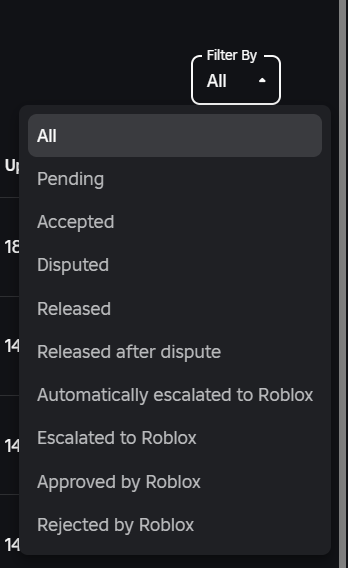
I have encountered a bug with the Rights Manager > Claims (Beta) feature.
Normally, when submitting a claim against catalog items, development items, or other types of content on the platform, the claimed content’s visibility and monetization are restricted immediately. As stated at the top of the Claims page:

Additionally, the Roblox Terms of Use (Creator Terms, Section 2(b)(viii)) also references the claims feature. For reference: https://en.help.roblox.com/hc/en-us/articles/115004647846-Roblox-Terms-of-Use#intellectual-property
Issue:
When I submit a claim against meshes or images, the claimed asset’s visibility is not affected at all, regardless of the claim status. This behavior contradicts how the feature is supposed to function.
For catalog UGC items, claims work as expected – once a claim is submitted (pending, accepted, or approved by Roblox), the UGC item is immediately taken offsale and becomes undiscoverable until further resolution.
However, for meshes and images, their discoverability remains completely unaffected.
Expected Behavior:
For meshes and images, visibility should be restricted immediately under the following claim statuses, just like with catalog UGC items:
- Pending
- Accepted
- Approved by Roblox
In other words, they should no longer appear publicly (similar to being archived) until the claim is resolved in favor of the other party (e.g., disputed or rejected).
Example Case:
I submitted a claim against the following mesh: https://create.roblox.com/store/asset/135777161419351/Mesh (Claim ID: 66e82c76-50f1-4b97-b733-e834495ceac6)
- The claim stayed in Pending for 7 days.
- The other party did not dispute or accept the claim, so it was automatically Accepted after 7 days.
- Despite this, the mesh remained visible and discoverable, which indicates the restriction system is not applying correctly to meshes/images.


Note: Replies discussing the validity of this claim or how original my item is in terms of copyright will be flagged, as that is not the point of this report and adds nothing to it. The issue being reported here is specifically that accepted claims on meshes do not restrict visibility. This is indeed a bug and should be addressed separately from any example case, since it concerns the functionality of the system itself rather than the validity of any specific claim.
The other party had 7 days to dispute and did not, so that is their fault. Replies accusing me of abusing the system or suggesting I should be reported will also be flagged, as they do not contribute anything either. If you intend to report me, please use the proper channels – replying here is not one of them: https://en.help.roblox.com/hc/en-us/articles/203312410-How-to-Report-Rule-Violations
Thank you for reviewing this issue.
Page URL: https://create.roblox.com/dashboard/rights-manager/claims