Hi! With the full release of Parallel Lua, I decided to convert a Unit/NPC implementation to using parallel lua. I wanted to get some feedback to ensure that I am using this feature correctly and efficiently in my implementation.
The original implementation had a single client sided ModuleScript class act as the unit object. I would call unit:Start(), unit:Stop(), unit:UpdateVisual(), ect… in order to replicate it’s position on the server.

My new implementation with parallel lua made me throw a bit of the design out of the window as I could not connect any parallel threads without actor instances. It now looks something like this:
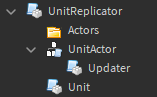
The UnitReplicator receives updates from the server that a unit has been created and that a client sided ones now needs to be made. It clones the UnitActor instance and calls Updater:Load(...) to set up the unit/attributes with the correct properties. The UnitActor instance has attributes attached to it to allow me to edit properties on without some sort of scope issue due to the actor.
Let me know if more info is needed to understand what I’m doing. Here are relevant snippets from my implementation:
“UnitActor” attributes

Here is the relevant “UnitReplicator” code:
UnitReplication.OnClientEvent:Connect(function(action, args)
    if action == "update" then
        local unit = UnitReplicator.Units[args.id]
        if not unit then
            local newUnitActor = UnitActor:Clone()
            newUnitActor.Parent = Actors

            local unitUpdater = require(newUnitActor.Updater)
            unitUpdater:Load(args)

            UnitReplicator.Units[args.id] = {
                actor = newUnitActor,
                updater = unitUpdater
            }

            unit = UnitReplicator.Units[args.id]
        end

        unit.actor:SetAttribute("Active", true)
    elseif ... then
       ...
    end
Here is the “Updater” module code:
if script.Parent.Parent:IsA("ModuleScript") then return end

local Actor = script.Parent
local UnitObject = require(Actor.Parent.Parent.Unit)

local activeSignal = Actor:GetAttributeChangedSignal("Active")
local visibleSignal = Actor:GetAttributeChangedSignal("Visible")
local healthSignal = Actor:GetAttributeChangedSignal("Health")
local startTimeSignal = Actor:GetAttributeChangedSignal("StartTime")
local pauseTimeSignal = Actor:GetAttributeChangedSignal("PauseTime")

local Updater = {}

function Updater:Load(unitProperties)
    Actor.Name = unitProperties.id
    Actor:SetAttribute("StartTime", unitProperties.startTime)
    Actor:SetAttribute("MaxHealth", 100)
    Actor:SetAttribute("Health", Actor:GetAttribute("MaxHealth"))

    self.unit = UnitObject.new(Actor, unitProperties)

    self.active = false
    self.visible = true

    self.replicateConnection = nil
end

function Updater:Destroy()
    if self.replicateConnection then self.replicateConnection:Disconnect() end
    self.unit:Destroy()
end

function Updater:ActiveChanged()
    self.active = Actor:GetAttribute("Active")

    if self.replicateConnection then self.replicateConnection:Disconnect() end
    if not self.active then return end

    while self.active and self.visible do
        task.synchronize()
        self.unit:UpdateVisual()
        task.desynchronize()

        task.wait()
    end
end

function Updater:PauseTimeChanged()
    self.unit.pauseTime = Actor:GetAttribute("PauseTime")
end

function Updater:HealthChanged()
    task.synchronize()
    self.unit:SetHealth(Actor:GetAttribute("Health"))
    task.desynchronize()
end

activeSignal:ConnectParallel(function()
    Updater:ActiveChanged()
end)

pauseTimeSignal:ConnectParallel(function()
    Updater:PauseTimeChanged()
end)

healthSignal:ConnectParallel(function()
    Updater:HealthChanged()
end)

return Updater
Here is the “Unit” code:
local RunService = game:GetService("RunService")
local ReplicatedStorage = game:GetService("ReplicatedStorage")

local SharedObjects = ReplicatedStorage:WaitForChild("SharedObjects")
local Path = require(SharedObjects:WaitForChild("Path"))

local RepAssets = ReplicatedStorage:WaitForChild("Assets")
local EnemyAssets = RepAssets:WaitForChild("Enemies")
local BillboardAssets = RepAssets:WaitForChild("Billboards")

local function processUnitModel(model)
    local humanoid = model:FindFirstChildWhichIsA("Humanoid")
    if humanoid then
        humanoid:SetStateEnabled(Enum.HumanoidStateType.FallingDown, false)
        humanoid:SetStateEnabled(Enum.HumanoidStateType.Running, false)
        humanoid:SetStateEnabled(Enum.HumanoidStateType.RunningNoPhysics, false)
        humanoid:SetStateEnabled(Enum.HumanoidStateType.Climbing, false)
        humanoid:SetStateEnabled(Enum.HumanoidStateType.StrafingNoPhysics, false)
        humanoid:SetStateEnabled(Enum.HumanoidStateType.Ragdoll, false)
        humanoid:SetStateEnabled(Enum.HumanoidStateType.GettingUp, false)
        humanoid:SetStateEnabled(Enum.HumanoidStateType.Jumping, false)
        humanoid:SetStateEnabled(Enum.HumanoidStateType.Landed, false)
        humanoid:SetStateEnabled(Enum.HumanoidStateType.Flying, false)
        humanoid:SetStateEnabled(Enum.HumanoidStateType.Freefall, false)
        humanoid:SetStateEnabled(Enum.HumanoidStateType.Seated, false)
        humanoid:SetStateEnabled(Enum.HumanoidStateType.PlatformStanding, false)
        humanoid:SetStateEnabled(Enum.HumanoidStateType.Dead, false)
        humanoid:SetStateEnabled(Enum.HumanoidStateType.Swimming, false)

        humanoid:ChangeState(Enum.HumanoidStateType.Physics)
    end

    for _,object in model:GetDescendants() do
        if object:IsA("BasePart") then
            object.CanCollide = false
            object.CanTouch = false
            object.CanQuery = false
        end
    end
end

local Unit = {}
Unit.__index = Unit

function Unit.new(actor, unitProperties)
    local newUnit = {}
    newUnit.actor = actor

    newUnit.id = unitProperties.id
    newUnit.path = Path.new(unitProperties.pathFolder)

    newUnit.maxHealth = actor:GetAttribute("MaxHealth")
    newUnit.health = actor:GetAttribute("Health")
    newUnit.startTime = actor:GetAttribute("StartTime")
    newUnit.pauseTime = actor:GetAttribute("PauseTime")

    newUnit.model = EnemyAssets.Enemy:Clone()
    newUnit.model.Parent = workspace.Enemies

    processUnitModel(newUnit.model)

    newUnit.healthBar = BillboardAssets["HealthBar"]:Clone()
    newUnit.healthBar.Frame.NameFrame.Label.Text = "Enemy_"..math.random(1,500)
    newUnit.healthBar.Parent = newUnit.model.PrimaryPart

    setmetatable(newUnit, Unit)

    return newUnit
end

function Unit:SetHealth(health)
    if self.healthBar.Parent ~= nil then
        self.health = math.max(0, health)
        self.healthBar.Frame.HealthFrame.Container.Bar.Size = UDim2.fromScale(self.health / self.maxHealth, 1)
    end
end

function Unit:UpdateVisual()
    local cframe = self:GetCFrame()
    self.model:PivotTo(cframe)
end

function Unit:Destroy()
    self.model:Destroy()
end

function Unit:GetCFrame()
    local travelTime = (workspace:GetServerTimeNow() - self.startTime) - self.pauseTime
    local nextNode, currentPosition = self.path:GetLocationFromTime(travelTime, 5, self.currentNode)

    self.currentNode = nextNode - 1
    return CFrame.new(currentPosition, self.path.nodes[nextNode].cframe.Position)
end

function Unit:Hide()
    self.model:PivotTo(CFrame.new(100000, 100000, 0))
end

return Unit
Edit:
I did some tests with the parallel version vs the unparallel version. Weirdly enough the unparallel version performs a lot better. Both get some moderate lag when spawning a unit every 0.01 seconds as you can see here:
Non-Parallel:

Parallel:
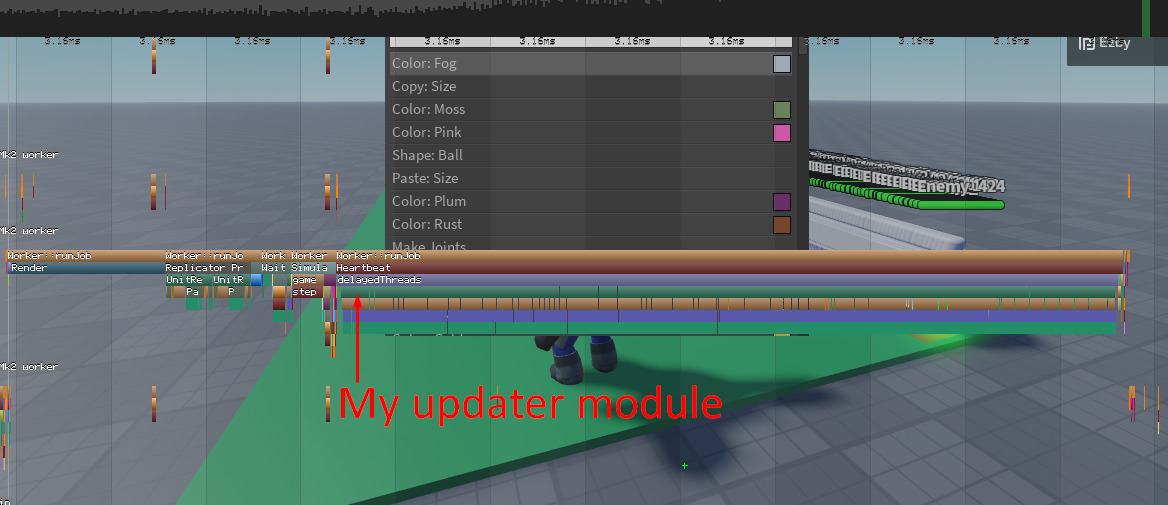
I also did an edited version of the parallel implementation that separated the unit’s cframe and PivotTo(…) functionality so I could do the cframe calculations in parallel without having to synchronize for the PivotTo(…):

However this was even worse performance wise. I am definitely doing something wrong here.
