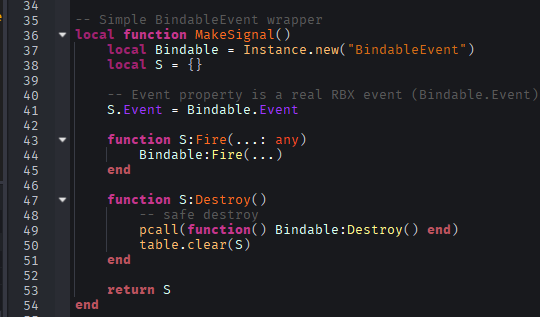
Really hate coding to save a player’s data? Well hate no more with my DataStoreLoaderObject Class that has type annotation and easy usage.
Ive decided to make this for no reason at all.
======================== Contructor ========================

Code Example on how to create a new DataStoreLoaderObject or loader for short
It only takes the datastore name to create one, if none was given then it will return nil and error. You can optionally put a table as default data if data was unsuccessfully loaded / saved.
It has a registry so you can get a loader if it was created

Code example on getting a loader
But you can just use CreateNewDataStoreLoaderObjectSync as it returns existing loaders if there are ones.
=================== Loader API ==================
Methods -----------------------------------------------------

GetDataStore() : returns the datastore associated with the name givenGetName() : returns only the datastore’s nameGetDefaultData() : returns the default data if there is one else nil
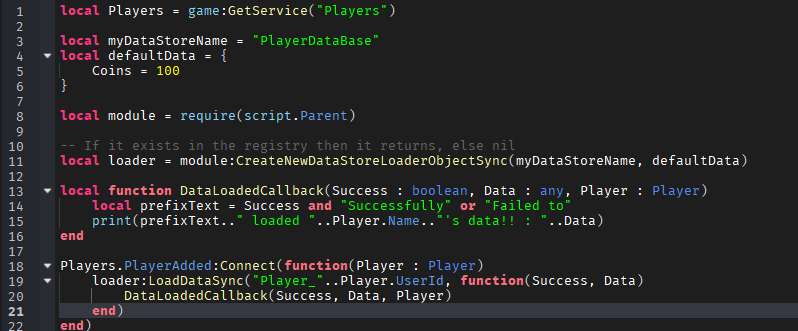
LoadDataSync(Key, Callback) : Loads data. Takes a key and an optional callback. After the data is loaded, it will be registered in the session which is necessary for the other methods. After the data loads, the callback will be called giving Success and the Data
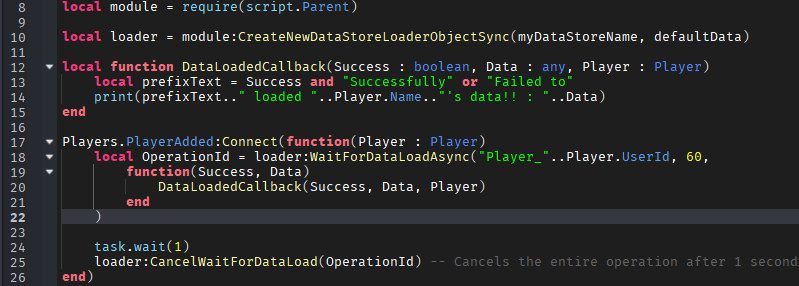
WaitForDataLoadAsync(Key, Timeout, Callback) : Just like LoadDataSync but it waits indefinitely just for data to load. It runs on another thread to return an unique OperationId string. The data is loaded for Timeout seconds which is clamped between 0 seconds and 10 minutes, defaultly 2 minutes. After the data is loaded or the wait was cancelled, it will call Callback.
CancelWaitForDataLoad(OperationId) : Using the operation id returned by the WaitForDataLoadAsync method, will cancel the wait and in the callback of the method will get false and nil.
GetSessionInfo() : returns a table which is the session and the SessionLock which prevents data duping and loss. A session is a table full of keys loaded by LoadDataSync or WaitForDataLoadAsync, nothing can be registered in the session without loading or raw modifying.
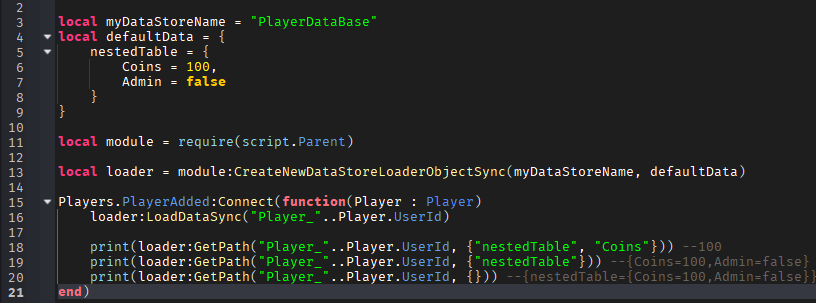
GetPath(Key, Path : {string}) : returns the value in a path of a data. It takes a table full of strings or keys which tell the hierchary. This is made for nested values. If the path leads to nothing then it returns nil
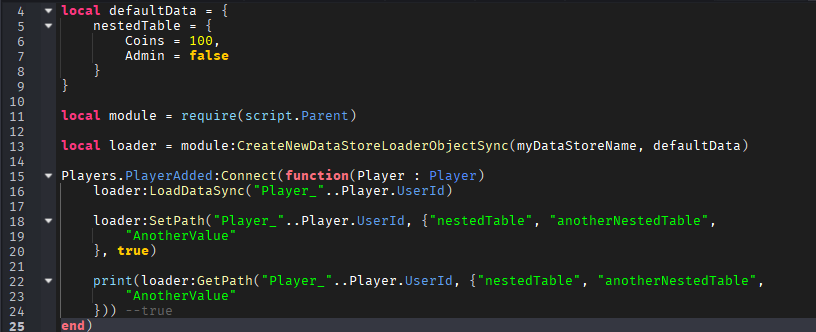
SetPath(Key, Path : {string}, NewValue) : It sets a value of a key using the path for nested values. If no more path was found then it creates a new table until it reaches its goal meaning it creates intermediete tables on the way. Sets the last value of the path to NewValue
SetPathNoCreate(Key, Path : {string}, NewValue) : Just like SetPath but it only sets a value if the path exists. If the path is unexisting then it will stop, else it will set the value of the last value of the path to NewValue meaning it doesnt create new paths.
PathExists(Key, Path : {string}) : Checks if a path exists in Key. If it does exist then it will return true, else false.
– For keeping track of data or Session Methods
Serialize(Key) : returns a deep copy of the session or a key value without its session lock.
GetSession(Key) : returns the raw session or a raw key value.
ResetToDefault(Key) : resets the value of all or a key to DefaultData if there is one. If there is no key given then it will save all data and reset the session to an empty table.
ExportSession() : returns a deep copy of the session.
Set(Key, Value) : sets the value of Key to Value.
RemoveKey(Key, Path : {string}) : removes a key or sets a key to nil using Path in Key.
Increment(Key, Path : {string}, Amount) : increments a number value by Amount in a Path of Key.
Append(Key, Path : {string}, Value) : appends a table or adds Value to the end of the table which is the last key of Path of Key. If path doesnt exist then it stops.
Merge(Key, Dictionary : {}) : merges the entire key session with Dictionary.
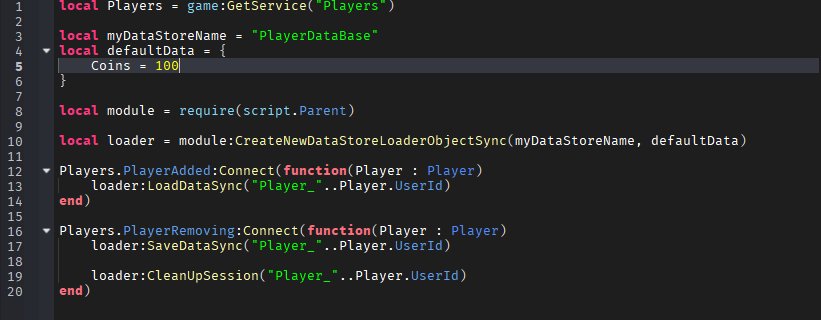
SaveDataSync(Key, Callback) : Saves data for Key and whether it was successful or not, Callback giving the key is called if it exists.
CleanUpSession(Key) : Cleans up the session of Key or if none was given then the entire session. Recommended after a player leaves the server.
GetValueFromStoreAsync(Key, Callback) : Runs on another thread, returns a value using
Key. Then calls Callback with the 1st argument as the success and the 2nd as the value got.
Destroy() : Attempts to save keys, cancel operations, destroy signals, and unregisters.
Events -------------------------------------------------------
OnDataLoaded : Fires after data successfully loads, returns the key and the data that was loaded.
OnDataLoadFailed : Fires after data fails to load, returns the key that was attempted to load.
OnDataSaved : Fires after data successfully saves, returns the key that was saved
OnDataSaveFailed : Fires after data fails to save, returns the key that was attempted to
save.
OnSessionChanged : Fires after the following methods called SetPath("SetPath"), SetPathNoCreate("SetPath"), ResetToDefault("Reset"), Set("Set"), RemoveKey("Remove"), Increment("Increment"), Append("Append"), Merge("Merge"). The strings next to the method names are the action name returned as the argument #2 of the callback of the connection.
Example Code :
loader.OnSessionChanged:Connect(Key, Action)
    print("Session was changed for "..Key.." by "..Action)
end
OnSessionReset : Fires after ResetToDefault was called. The 2nd argument of the callback of the connection will always be "Reset" and the 1st is the key associated with the reset.
OnDestroying : Fires after Destroy is called.
Here’s the module sources.
DataStoreLoaderModule / MainModule
DatastoreLoaderModule.lua (27.7 KB)
I dont think you have to read all of that since there’s type annotation and explanatory parameters, method names, and signal names.